Pages

Showing posts with label physiology. Show all posts

Wednesday, 13 July 2011

More Vulcan Physiology? Okay.

I have been writing and posting about Vulcan physiology a lot lately, and this will be no different. It is... fascinating.

Did I mention that there will be a post focused on Vulcan reproduction in the next couple days as well?

Anyways, going back to the Star Fleet Medical Reference Manual (again), lets get down to the facts (click to enlarge):


This basically goes over most of what I had mentioned in earlier posts - blood pressure, respiration, etc. However, there are additional details. (Who's ready for more accuracy ranting?)

In novels and fan fiction, there is a recurring theme - Vulcans' "hot" skin. They write about how when a human touches a Vulcan, they are surprised about how warm the Vulcan feels. Obviously, this bothers me. It is a fact that the average body temperature of a Vulcan is 91 degrees Fahrenheit, where as the average human body temperature is 98.6 degrees - Vulcans should then, be colder to the touch, as humans have a much higher body temperature.

Finally, I present to you - a diagram of a Vulcan's internal organs! (yay)


As you can see, the Vulcan heart is indeed where a human liver would be, with the Vulcan liver directly underneath it. The lungs are larger, and their bodies are generally leaner (as evident in top chart, average weight and height).

It is also important to note that this is accurate for all Vulcanoid species, such as Romulans, Mintakans (a proto-Vulcan race),  and "Rigel V subspecies".

Thursday, 7 July 2011

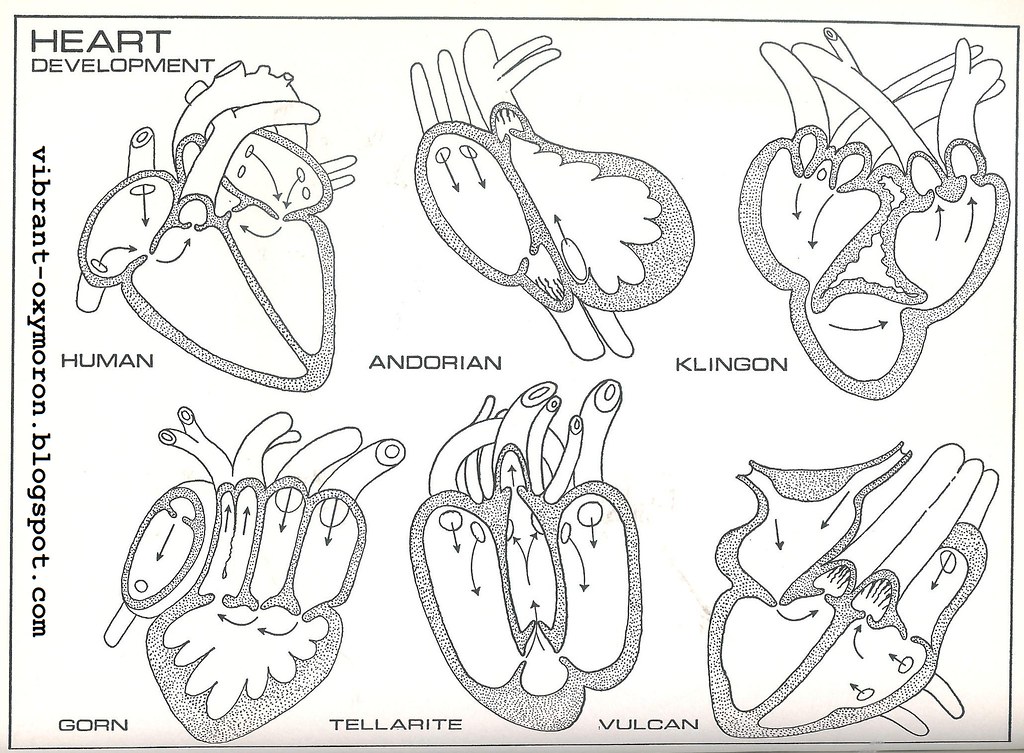
Cranial, Brain, and Heart Development: Human, Andorian, Klingon, Gorn, Tellarite, Vulcan

Did I ever mention I am the (very) proud owner of the fully illustrated Star Fleet Medical Reference Manual? It is epic - I mean, the medical advisor is listed as Leonard McCoy, MD.


One of the super-cool sections in this book shows the differences in cranial, heart, and brain development between Humans, Andorians, Klingons, Gorn, Tellarites, and Vulcans.

Now anyone who knows me also knows that I somewhat obsessive about Vulcan biology and culture - other species, not as much. Because of this, I will quickly go over what these illustrations tell us about Vulcan physiology, while completely ignoring every other species (except for human).


The Vulcan skull is considerably larger than that of humans, with harder bone that is about 0.2cm thicker around the brain. It is also said that Vulcan males do not possess the "supraorbital taurus" (bony ridges above the eye socket).

Now let's check out them brains!


The Vulcan brain and the Human brain have the same overall structure and size, however the midbrain is significantly different in Vulcans. This midbrain is where telepathic and telekinetic powers originate - the Vulcan midbrain is larger and far more intricate, explaining to a certain extent their psionic powers.

Last one - the heart.


The Vulcan heart beats at 242 minutes, and the average blood pressure is 80 systolic, and 40 diastolic (the blood vessels are extremely dilated). Blood vessels with a large diameter help cool the body. The heart is contained where a the liver would be in a human, thus leaving room for their larger lungs. The cartilage that would normally protect a human heart extends an extra 3.5 cm down to protect the Vulcan heart. The Vulcan heart is somewhat larger in size, extremely muscular, and has thinner walls (to allow for a greater pulse range and a greater volume of blood.

Bonus Fun fact:
Vulcan time is based on the beating of the heart and units of ten. Let's say, for this, that the Vulcan heart beats 240 times per earth minute. 100 Vulcan heart beats is equal to one Vulcan minute. A Vulcan minute is equal to 25 standard seconds, and 24 standard minutes is equal to ten Vulcan minutes. (Strangers from the Sky - Margaret Wander Bonanno)