Pages

Showing posts with label diagram. Show all posts

Sunday, 8 April 2012

Horta Facts and Biology - Janus Hominidae

H is for Horta!

The Horta, introduced in the TOS episode "The Devil in the Dark" and originating on Janus VI, is a fine example of silicon-based life. Just as a human moves through air, the Horta is able to move through rock with incredible ease by secreting an extremely corrosive acid from their bodies. This creates the tunnels in which they reside - and through tunneling, they also gain nourishment from the rock. They may exist for periods of time in an oxygen atmosphere, but they did not evolve in this type of environment.

Illustration by Don Ivan Punchatz
The Horta are, because they are silicon based and not carbon based like most life forms, difficult to detect with tricorders and are invulnerable to type one phasers (they can be injured by an adjusted type two phaser).  Until the Horta was discovered on Janus VI in "the Devil in the Dark", there were no known silicon based life forms (even the Tcha'besheh or A'kweth is largely unknown).

The Horta do not posses any type of technology or weaponry - the acid produced by their bodies is not only for moving through rock, but for self defense as well.

Scanned from "Worlds of the Federation"
Approximately every fifty or sixty thousand years, all but one Horta dies. This lone Horta will then become the mother to thousands of eggs (silicone "nodules"), from which offspring will hatch. The eggs are stored in the "Vault of Tomorrow" in the "Chamber of Ages". It is then up to her to raise the young and protect them, a task which includes passing on the legends and myths of their society's history.

There have, according to many novels by Diane Duane, been Horta on starships such as the Enterprise, and according to the TNG novel "Dyson Sphere", Starfleet has starships entirely operated by Horta. I will go no further into the many appearances of Horta in comics and novels, or games at this time.

"Cellular" structure - Star Fleet Medical Reference Manual
According to the Star Fleet Medical Reference Manual:
"The Horta's internal structure is similar to that of a geode. At it's center lies a molten mass where the eggs develop after having seperated from the block of genetic material that serves as the ovary. Also located at the center is the brain, which is kept at a superheated temperature by the encompassing fluid. Thin veins of flowing magma radiate from the brain and form concentric curcles of nervous tissue in the Horta's plastic-like mesos, or middle layer." 
On the underside of the Horta, are a kind of cilia upon which it moves. Below is a diagram from the same manual, with corresponding labels underneath:

Star Trek Medical Reference Manual
A - Nervous system

B - Central nervous system

C - Mesos

D - Cutis

E - Acid jets

F - Magma duct
G - Protos musculus

H - Flexible mantle

I - Ovary

J - Atrium

K - Ovum

L - Shag

Friday, 8 July 2011

Vulcan Cardiac Arrest

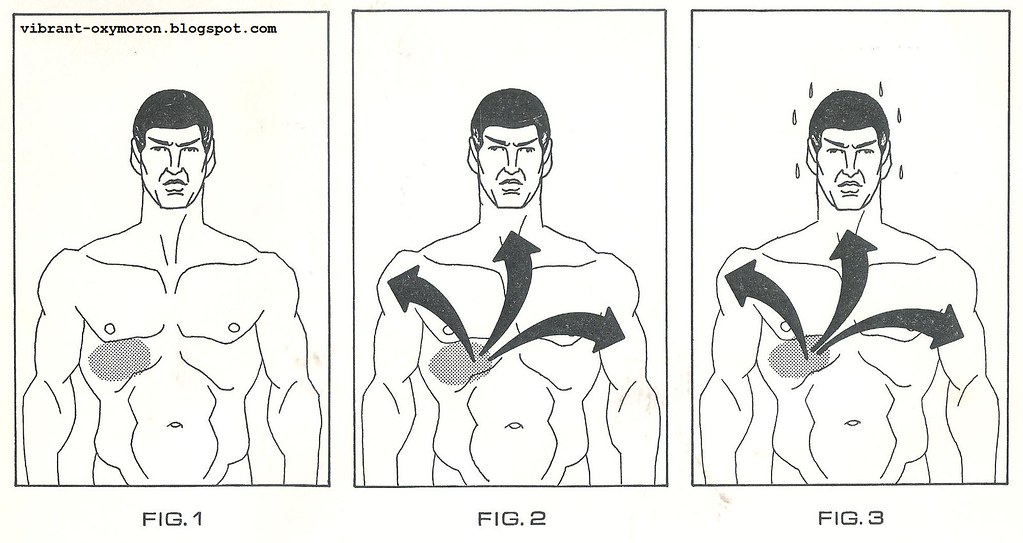
A Vulcan cardiac arrest is caused by a malfunction in one of the heart valves (for diagram of heart, go HERE). It is similar to heart attacks in a human, however it is almost impossible to tell for sure without an operation.

If you recall (and I hope you do!), Sarek suffered from a cardiac arrest (as he had been for quite some time already) during the Coridan debate in "Journey to Babel". Without a transfusion, the operation would not have been carried out because of the unique structure of the Vulcan heart (ordinary heart surgery is impossible as well, it must be specialized and use specific equipment). Luckily both Sarek and Spock had T-negative blood, and were compatible despite the fact that Spock does have some human elements in his blood.


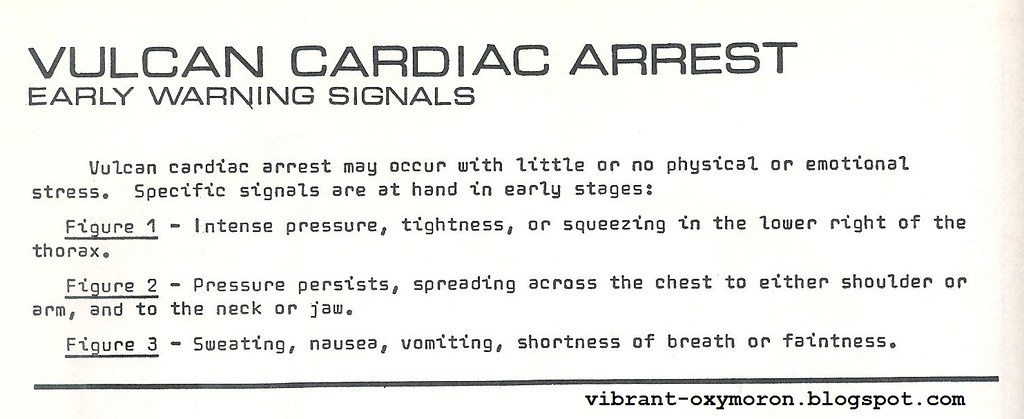
Going back to the handy Star Fleet Medical Reference Manual I had mentioned in an earlier post, we find a handy little chart for diagnosing cardiac arrest in Vulcans, complete with warning signs and a spiffy diagram.


Interestingly enough (or not) the Vulcan in the diagram kind of resembles Sarek.


Basically, heart failure in Vulcans is caused by pulmonary and systemic congestion, in turn caused by inadequate systolic flow and the delayed venous return of copper-based blood.

The drug Benjisidrine, originally synthesized from the Vulcan benjisi plant, is often prescribed (as it was to Sarek)to prevent congestive heart failure in Vulcans. It increases the strength of myocardial contractions.

The More You Know.