Pages

Showing posts with label biology. Show all posts

Sunday, 8 April 2012

Horta Facts and Biology - Janus Hominidae

H is for Horta!

The Horta, introduced in the TOS episode "The Devil in the Dark" and originating on Janus VI, is a fine example of silicon-based life. Just as a human moves through air, the Horta is able to move through rock with incredible ease by secreting an extremely corrosive acid from their bodies. This creates the tunnels in which they reside - and through tunneling, they also gain nourishment from the rock. They may exist for periods of time in an oxygen atmosphere, but they did not evolve in this type of environment.

Illustration by Don Ivan Punchatz
The Horta are, because they are silicon based and not carbon based like most life forms, difficult to detect with tricorders and are invulnerable to type one phasers (they can be injured by an adjusted type two phaser).  Until the Horta was discovered on Janus VI in "the Devil in the Dark", there were no known silicon based life forms (even the Tcha'besheh or A'kweth is largely unknown).

The Horta do not posses any type of technology or weaponry - the acid produced by their bodies is not only for moving through rock, but for self defense as well.

Scanned from "Worlds of the Federation"
Approximately every fifty or sixty thousand years, all but one Horta dies. This lone Horta will then become the mother to thousands of eggs (silicone "nodules"), from which offspring will hatch. The eggs are stored in the "Vault of Tomorrow" in the "Chamber of Ages". It is then up to her to raise the young and protect them, a task which includes passing on the legends and myths of their society's history.

There have, according to many novels by Diane Duane, been Horta on starships such as the Enterprise, and according to the TNG novel "Dyson Sphere", Starfleet has starships entirely operated by Horta. I will go no further into the many appearances of Horta in comics and novels, or games at this time.

"Cellular" structure - Star Fleet Medical Reference Manual
According to the Star Fleet Medical Reference Manual:
"The Horta's internal structure is similar to that of a geode. At it's center lies a molten mass where the eggs develop after having seperated from the block of genetic material that serves as the ovary. Also located at the center is the brain, which is kept at a superheated temperature by the encompassing fluid. Thin veins of flowing magma radiate from the brain and form concentric curcles of nervous tissue in the Horta's plastic-like mesos, or middle layer." 
On the underside of the Horta, are a kind of cilia upon which it moves. Below is a diagram from the same manual, with corresponding labels underneath:

Star Trek Medical Reference Manual
A - Nervous system

B - Central nervous system

C - Mesos

D - Cutis

E - Acid jets

F - Magma duct
G - Protos musculus

H - Flexible mantle

I - Ovary

J - Atrium

K - Ovum

L - Shag

Thursday, 7 July 2011

Cranial, Brain, and Heart Development: Human, Andorian, Klingon, Gorn, Tellarite, Vulcan

Did I ever mention I am the (very) proud owner of the fully illustrated Star Fleet Medical Reference Manual? It is epic - I mean, the medical advisor is listed as Leonard McCoy, MD.


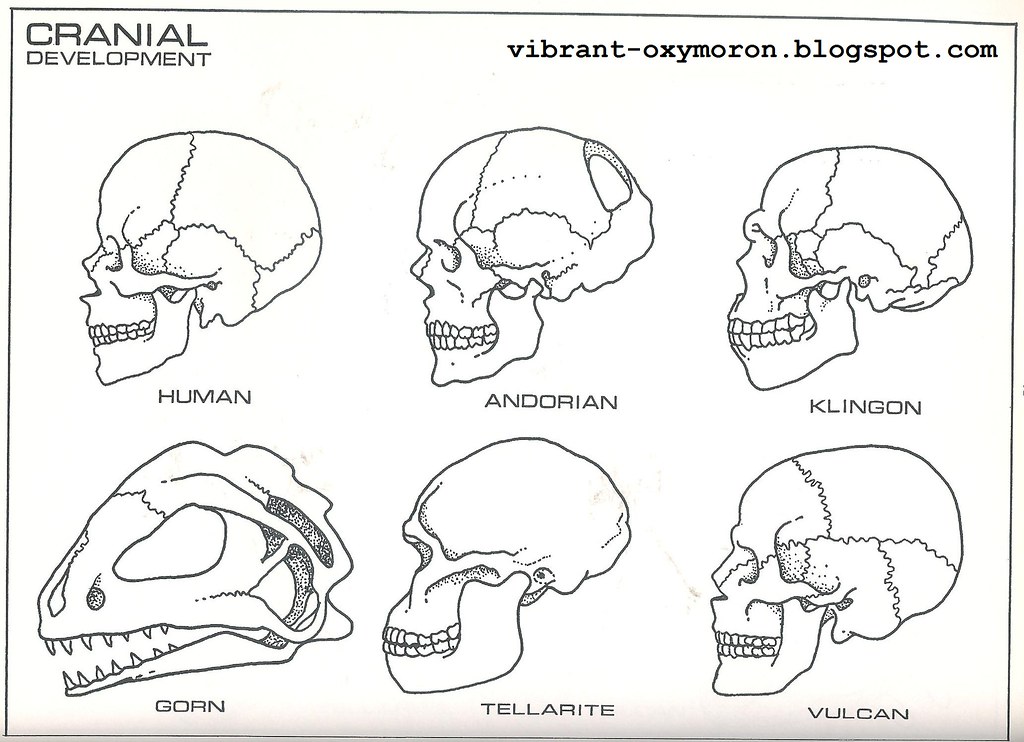
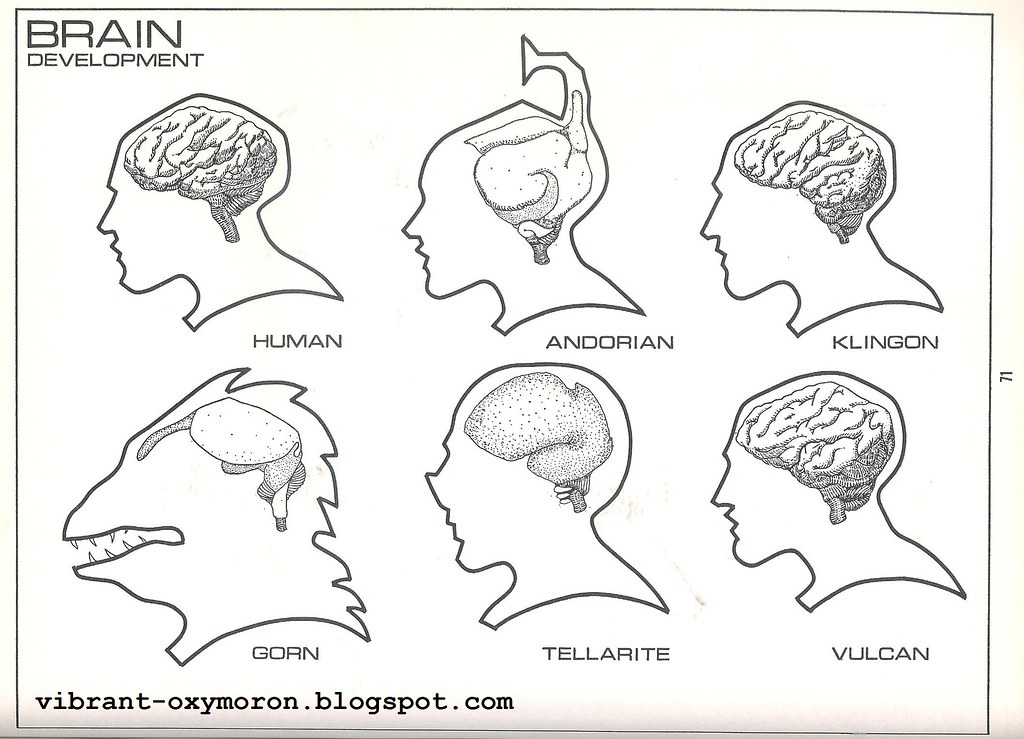
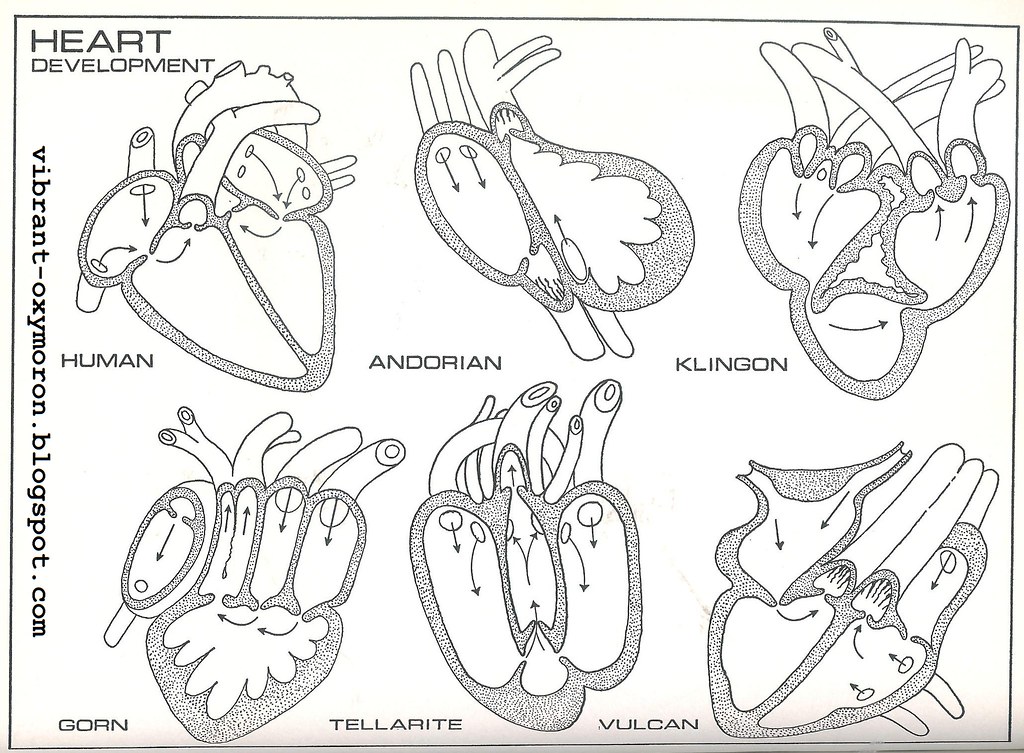
One of the super-cool sections in this book shows the differences in cranial, heart, and brain development between Humans, Andorians, Klingons, Gorn, Tellarites, and Vulcans.

Now anyone who knows me also knows that I somewhat obsessive about Vulcan biology and culture - other species, not as much. Because of this, I will quickly go over what these illustrations tell us about Vulcan physiology, while completely ignoring every other species (except for human).


The Vulcan skull is considerably larger than that of humans, with harder bone that is about 0.2cm thicker around the brain. It is also said that Vulcan males do not possess the "supraorbital taurus" (bony ridges above the eye socket).

Now let's check out them brains!


The Vulcan brain and the Human brain have the same overall structure and size, however the midbrain is significantly different in Vulcans. This midbrain is where telepathic and telekinetic powers originate - the Vulcan midbrain is larger and far more intricate, explaining to a certain extent their psionic powers.

Last one - the heart.


The Vulcan heart beats at 242 minutes, and the average blood pressure is 80 systolic, and 40 diastolic (the blood vessels are extremely dilated). Blood vessels with a large diameter help cool the body. The heart is contained where a the liver would be in a human, thus leaving room for their larger lungs. The cartilage that would normally protect a human heart extends an extra 3.5 cm down to protect the Vulcan heart. The Vulcan heart is somewhat larger in size, extremely muscular, and has thinner walls (to allow for a greater pulse range and a greater volume of blood.

Bonus Fun fact:
Vulcan time is based on the beating of the heart and units of ten. Let's say, for this, that the Vulcan heart beats 240 times per earth minute. 100 Vulcan heart beats is equal to one Vulcan minute. A Vulcan minute is equal to 25 standard seconds, and 24 standard minutes is equal to ten Vulcan minutes. (Strangers from the Sky - Margaret Wander Bonanno)