Pages

Showing posts with label tellarite. Show all posts

Tuesday, 11 October 2011

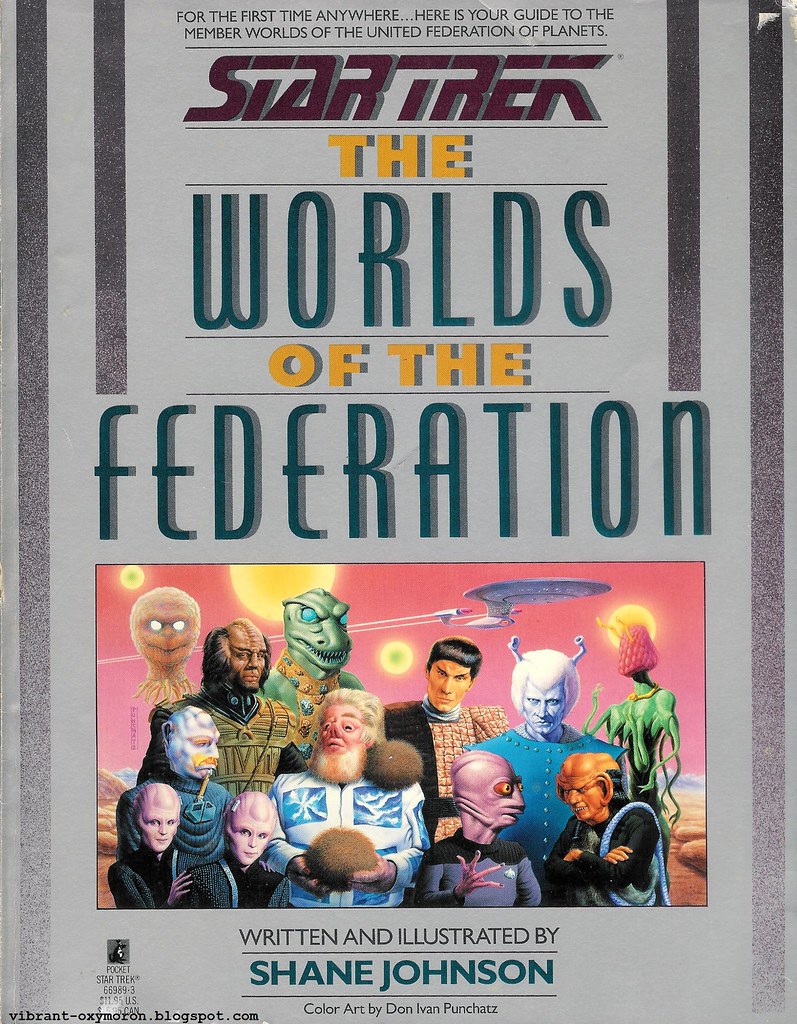
The Worlds of the Federation and Don Ivan Punchatz - 1989

"The Worlds of the Federation", written and illustrated by Shane Johnson, is one of my favorite resources. Inside this 155 page book one finds a historical overview of the United Federation of Planets, the Planetary Classification System (UFP Standard), and overview of all member worlds as well as their planet's primaries and ambassadors - as well as an overview of Neutral, Independent, and Hostile Worlds. One may also find each planet's system profile, planetary emblem, and continental profile.


While Shane Johnson illustrated the pages with drawings of continental systems, ambassadors, emblems, etc. - it was Don Ivan Punchatz who created the stunning color art we see on the cover, as well as inside on the glossed pages (which I will cover at a later date). I will focus now on the image on the front cover:
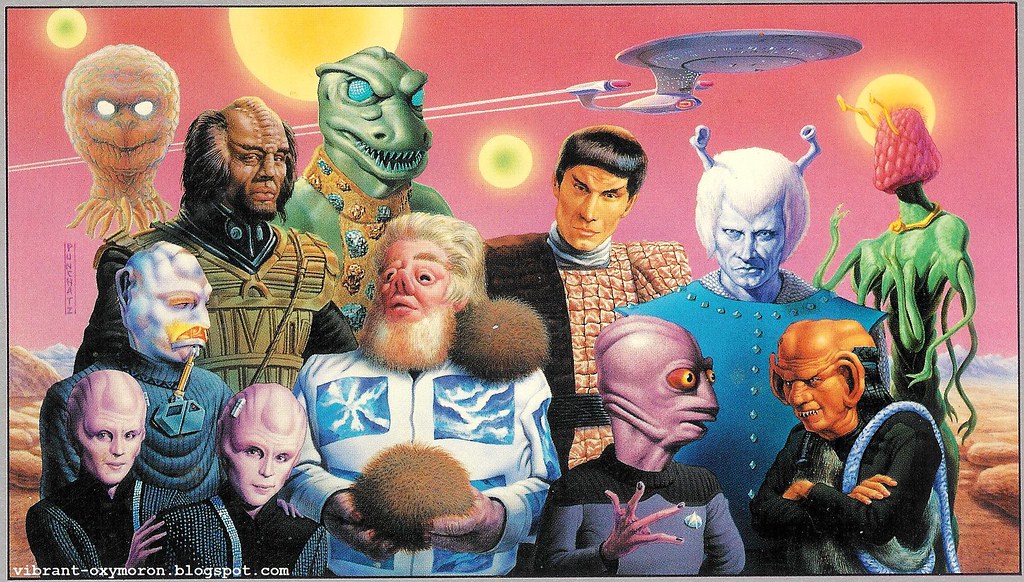

We also find the same image spread across two pages inside, allowing us to experience this masterpiece in great detail. For those who are unaware of the races depicted, I will go over them and state the episode they first appeared in: (Referring the the images below, Starting in top left, moving clockwise)
  • Melkot - Melkatians were seen in TOS: Spectre of the Gun
  • Klingon - The Klingons are well known, but first appeared in TOS: Errand of Mercy
  • Gorn - First seen in TOS: Arena
  • Tellarite - First seen in TOS: Journey to Babel (one of my favorite episodes, as we see Sarek and Amanda for the first time)
  • Tribbles - First seen in TOS: The Trouble with Tribbles
  • Bynars - First seen in TNG: 11001001
  • Benzite - First seen in TNG: Coming of Age
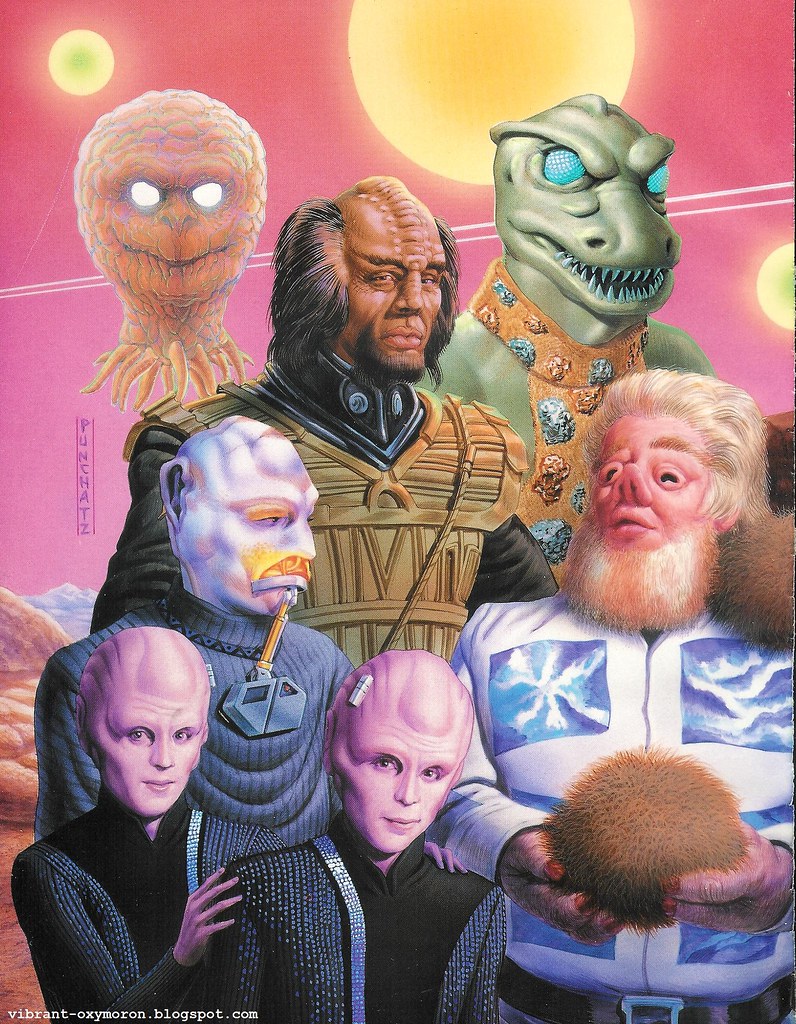
To enlarge the image, right click and open in a new tab or window.


      Moving on to the second page, we see the USS Enterprise NCC-1701-D over top of the five remaining races:
      • Romulan - First seen in TOS: Balance of Terror (played by Mark Lenard, the same man who played Sarek)
      • Andorian - First seen in TOS: Journey to babel (What is interesting about this image - is that the Andorian shown below, Thelev, was actually an Orian Assassin in disguise, and not an Andorian at all)
      • Phylosian - First seen in TAS: The Infinite Vulcan (another great episode)
      • Ferengi - First seen in TNG: The Last Outpost
      • Saurian (juvenile) -  First Seen in Star Trek: The Motion Picture (although Saurian Brandy has been enjoyed in TOS episodes beforehand)
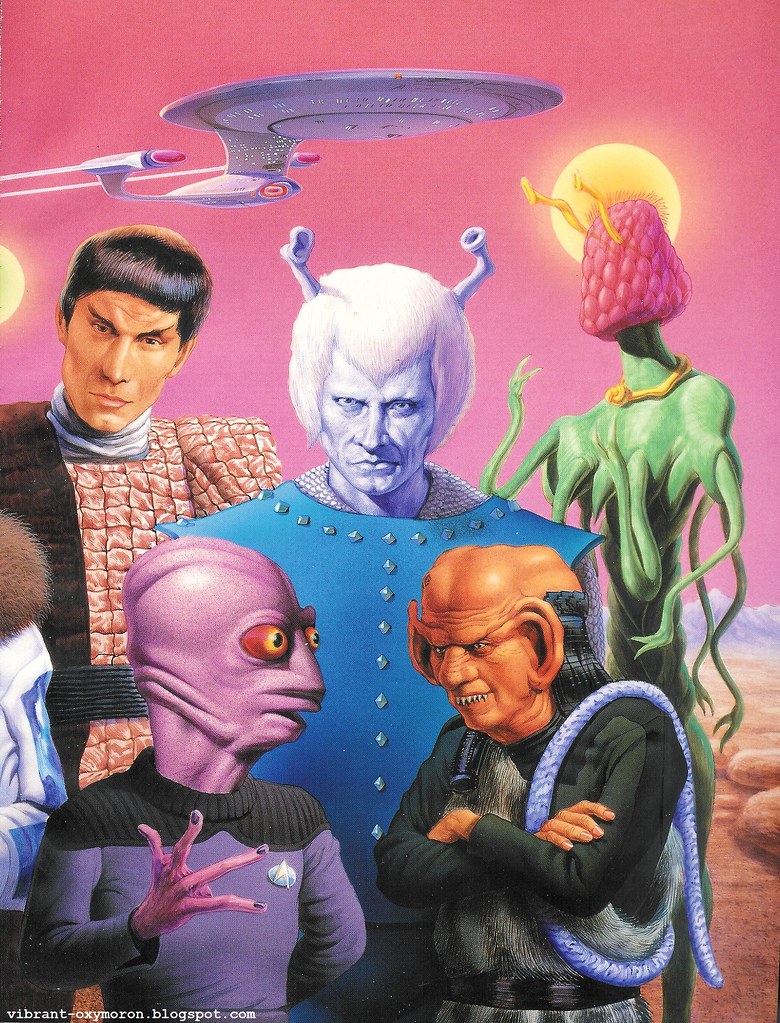

      I am absolutely in awe of this piece of art. I have been a fan of Don Ivan Punchatz for a while now, and a lot of his work can be found online - do a quick search on google images and you will understand. Everything he does is absolutely amazing.

      Thursday, 7 July 2011

      Cranial, Brain, and Heart Development: Human, Andorian, Klingon, Gorn, Tellarite, Vulcan

      Did I ever mention I am the (very) proud owner of the fully illustrated Star Fleet Medical Reference Manual? It is epic - I mean, the medical advisor is listed as Leonard McCoy, MD.


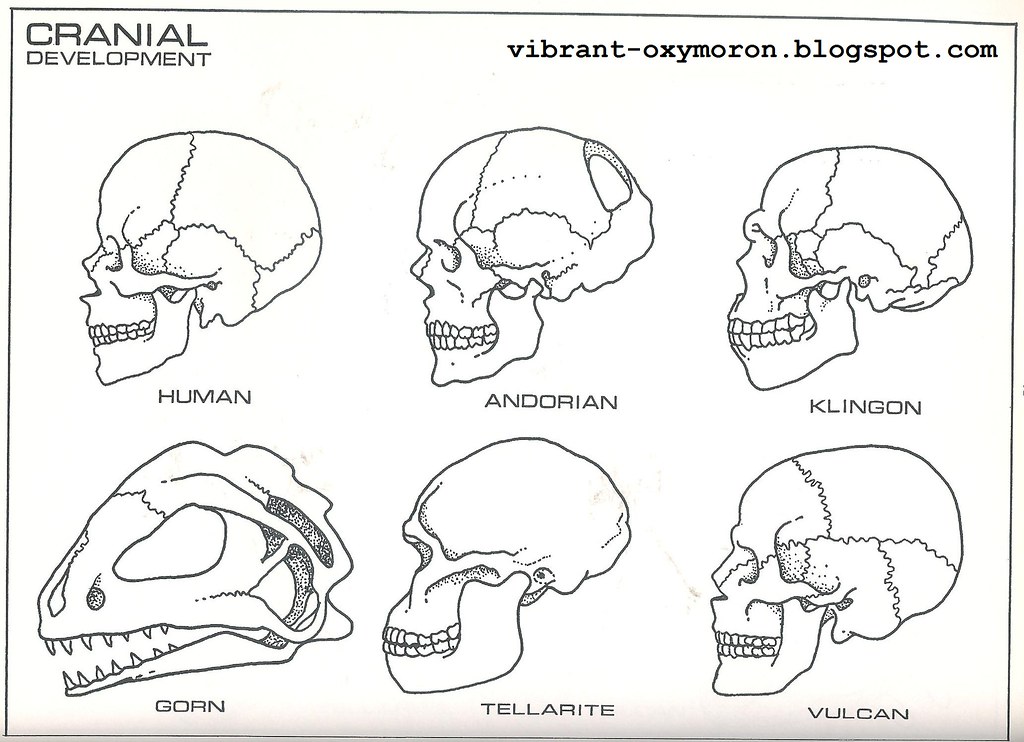
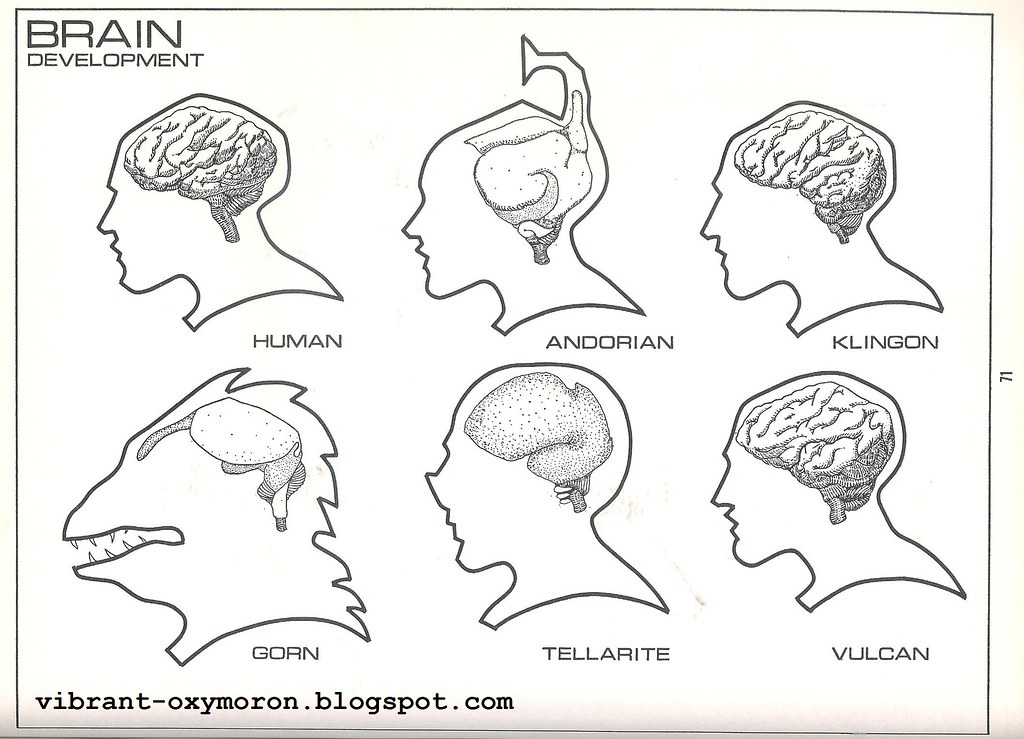
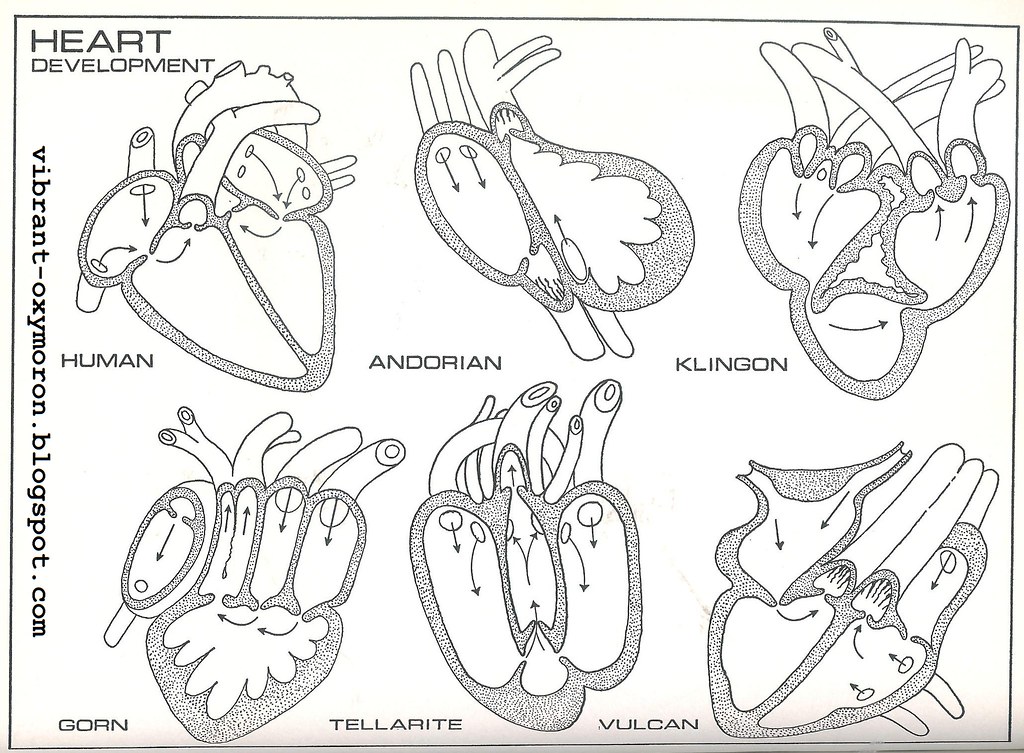
      One of the super-cool sections in this book shows the differences in cranial, heart, and brain development between Humans, Andorians, Klingons, Gorn, Tellarites, and Vulcans.

      Now anyone who knows me also knows that I somewhat obsessive about Vulcan biology and culture - other species, not as much. Because of this, I will quickly go over what these illustrations tell us about Vulcan physiology, while completely ignoring every other species (except for human).


      The Vulcan skull is considerably larger than that of humans, with harder bone that is about 0.2cm thicker around the brain. It is also said that Vulcan males do not possess the "supraorbital taurus" (bony ridges above the eye socket).

      Now let's check out them brains!


      The Vulcan brain and the Human brain have the same overall structure and size, however the midbrain is significantly different in Vulcans. This midbrain is where telepathic and telekinetic powers originate - the Vulcan midbrain is larger and far more intricate, explaining to a certain extent their psionic powers.

      Last one - the heart.


      The Vulcan heart beats at 242 minutes, and the average blood pressure is 80 systolic, and 40 diastolic (the blood vessels are extremely dilated). Blood vessels with a large diameter help cool the body. The heart is contained where a the liver would be in a human, thus leaving room for their larger lungs. The cartilage that would normally protect a human heart extends an extra 3.5 cm down to protect the Vulcan heart. The Vulcan heart is somewhat larger in size, extremely muscular, and has thinner walls (to allow for a greater pulse range and a greater volume of blood.

      Bonus Fun fact:
      Vulcan time is based on the beating of the heart and units of ten. Let's say, for this, that the Vulcan heart beats 240 times per earth minute. 100 Vulcan heart beats is equal to one Vulcan minute. A Vulcan minute is equal to 25 standard seconds, and 24 standard minutes is equal to ten Vulcan minutes. (Strangers from the Sky - Margaret Wander Bonanno)