Pages

Showing posts with label star fleet medical reference manual. Show all posts

Wednesday, 9 May 2012

Vita Xenos - Ornithoid Lifeform as seen on Pyris VII - Catspaw

Vita Xenos
The classification of "Vita Xenos" (Life Stranger) includes all intelligent life outside of the Milky Way galaxy. Very few species from outside of our galaxy have been discovered. Very little information is available when it comes to these beings. The brief information gathered on these aliens suggests that the developement of life outside of the galaxy differs very little from within our own.

Ornithoid Lifeform
The ornithoid (bird-like) life form seen on Pyris VII (Korob and Silvia - TOS episode "Catspaw") is one such outside species. From what we know from brief tricorder readings and the dissection of deceased specimens, these orthinoid lifeforms originated on a cold, dry planet with low atmospheric pressure and a very low gravity - about one sixth of the gravity of earth.


It is theorised that their primary source of nutrition is provided by liquids, due to their simple digestive tract and straw-like mouths. Their eyes have concave reflectors which capture and focus images. This species is known to be an advanced tool maker which is capable of space travel - because their claw-like limbs are not likely to provide sufficient manual dexterity, it is also theorised that their proboscis are used when handling and manipulating items.


Due to their transmuter technologies, they were able to amplify their mental abilities and survive on Pyris VII. When this technology (appearing as a wand) was destroyed, they were unable to survive on the planet due to their frail physiology and tiny stature.

It is also know that these beings answer to "the Old Ones", but it is unknown who or what the Old Ones are.

Note: The top image of the ornithoid lifeform was drawn by myself with a tablet. I scanned and edited the second image from the Star Fleet Medical Reference Manual.

Monday, 22 August 2011

Star Fleet Medical Reference Manual - History

I have posted scans from the Star Fleet Medical Reference manual before, focusing mainly on Vulcan physiology. Lately, however, I have noticed an expanding interest in the manual around the internet. So here I am, revisiting the reference manual - studying the history of medicine.

I had posted the cover of the reference manual here, but it also came with a loose cover within the protective case:


Inside, we find that the Medical Advisor for this manual is none other than Leonard McCoy, M.D.  That automatically makes this the best book in the entire world. It makes me glad that I found it before my friend did, who was right beside me looking on the same dusty shelf.


Below are some pages with the history of medicine, not limited to Earth. It is very interesting to see the different planets' timelines - how advanced Vulcan was, for instance, when Earth was still in the middle ages. Some of the highlights (in Earth years - click images to enlarge):

4200 BC - Great Plague on Vulcan, thousands die of the skag maug.

2750 BC - Kohl, Klingon god - patron of medicine.

1900 BC - Sikar, founder of the Vulcan School of Medicine.

Around 480 AD - Kassaba fever destroys entire populations of Rigel IV

Around 1000 AD - Zora experiments with body chemistry of tribes on Tiburon

1348-1350 AD - "Black Death", bubonic plague kills one-third of Europe.

Around 1530 AD - T'Laan of Vulcan discovers an artificial blood plasma. (It wasn't even until 1628 that William Harvey discovered the circulation of the blood on Earth)


According to this timeline, Louis Pasteur developed "pasteurizer and rabies vaccine" in around 1820. He was only born in 1822, and the first pasteurization tests took place in 1962.  He started working on a rabies vaccination in the 1880s...

Around 1960 AD - Birth of Stavos Keniculus, first cloned human. (Also spelled Stavos Keniclius. Dr McCoy had mentioned in TAS that the scientist would be around 250 years old, which means he would have been born in around 2019, as the episode took place in 2268.)

1992 AD - Eugenic "supermen" revealed to public. (Eugenics wars begin)

Around 2000 AD - "Green Death", Vegan choriomeningitis ravages Vega IX.

2002 AD - Nomad Probe launched to search for extraterrestrial life.

2005 AD - Cygnian Plague Vaccine developed by Zilzu of Tellar.

Around 2020 AD - Cancer-inhibiting plant compound discovered on Ganymede.

Around 2015 AD - Life on Lavinius V is destroyed by the flying parasites. (Other sources say 2060 and 2067)


2042 AD - Ka'hat plague spreads throughout the Klingonii worlds.

2046 AD - Sessek of Vulcan studies alien physiologies.

Around 2175 AD - Radioactive pollutants on scalos cause drastic mutation.

Around 2190 AD - Life on Theta Cygni is destroyed by the flying parasites. (Theta Cygni XII)

Around 2550 AD - Life on Ingraham B is destroyed by the flying parasites.

2267 AD - Silicon-base life discovered on Janus VI. (Horta!)

They should teach these things in school - if a Canadian can get a Master's degree in the Beatles, then I should be able to get one in Star Trek.

Friday, 15 July 2011

Vulcan and Vulcanoid Reproduction

The following contains mature subject matter and facts from numerous sources - episodes, novels, manuals, and the Vulcan Language Institute Reclamation Project.

After collecting facts on Vulcan reproduction and reproductive organs from (hyperbole time) a million and one sources, I present to you: an overview that took hours to write because i kept getting distracted. Enjoy, and learn.


The Pon Farr

It is a common misconception that Vulcan males only engage in sexual intercourse every seven years during the Pon Farr (first mentioned in Amok Time) - Vulcan males are capable of this at any time after maturation (perhaps without the ability for fertilization at these times). It is only during the Pon Farr that they must mate, or die. The reproductive glands are the only glands that Vulcans cannot totally control.

It has been suggested that this seven year cycle is influenced by the cycle of solar activity in the Vulcan star system - that they evolved to reproduce without fail during the one time when there was the lowest amount of solar activity and radiation levels were at their lowest. While this is an interesting theory, not all male Vulcans go through the Pon Farr at the same time.

The Star Fleet Medical Reference Manual states that when the Vulcans decided to "outlaw all emotion" they realized that they must first lessen the deadly lust that males experienced before mating. Each male was, at first, forced to control their urges by "sublimating and repressing" the physical symptoms. They could only keep this up for seven years at a time.

The Plak Tow (or Blood Fever) becomes stronger during the final stages of the Pon Farr and is initiated by a telepathic mating bond. During the Plak Tow Vulcans lose all emotional control and may become extremely violent. This fever and chemical/hormonal imbalance which will eventually to death if not broken by either succesful mating or through Koon-ut Kal-if-fee (a ritual combat). Some Vulcans, when unable to return to Vulcan, have attempted meditation as a solution.

Vorik, mad in the plak Tow.
Spock, deep in the Plak Tow.

Note: It has also been suggested that in response to harsher than usual environmental conditions, Vulcan males can mate at any time.

Male Reproductive Organs

The Vulcan Penis is covered by no external sheath or foreskin, and therefore circumcision has never been necessary. The reproductive organs are almost entirely retracted into the body as a protective measure. The two testes are formed close to the body, and a prostatic body that produces and stores seminal fluid - Vulcan sperm is viable for up to 30 minutes after ejaculation before losing mobility.

It is believed that Vulcan males remain fertile their entire adult lives.

Female

Possibly unlike males, female Vulcans are always fertile. As in humans, females have a vagina, uterus, and ovaries - unlike human females, Vulcan females lack uterine/fallopian tubes, as the ovaries are connected to the uterine body by short ducts. Menstruation is absent as a result of evolution and the need to retain as much water as possible in the hot Vulcan climate.


Ovulation occurs each month from altering ovaries, and it takes less than 24 hours for the ovum to enter the uterus. After this occurs, one of two things can happen.
     1. The ovum is fertilized - the blastocyst implants itself in the uterine wall, and hormones activate the formation of the placenta. Growth and development occurs in the uterus, and birth is given vaginally. (Caesarian section is rare, but not unheard of in Vulcans.)
     2. No fertilization occurs - if no fertilization occurs within 10-14 days, the ovum deteriorates and is absorbed  into the uterine lining.

Multiple Births

For a Vulcan female to give birth to twins is very rare, and multiples of more than three is unheard of. As far as twins are concerned, fraternal twinning is highly uncommon, whereas identical twins are the norm. The idea of giving birth to multiples is considered repugnant among Vulcans.

It has been said that females rarely give birth to more than two children in their lifetime, however Vulcans on colony worlds have been known to have as many as five children. This as well as the low twinning rate may also be due evolution and harsh environmental conditions.


Romulan male and female (TNG and on)
Romulans

These facts are generally the same for all Vulcanoids, including Romulans (as the descendants of Vulcan emigrants) except:

- Romulans no longer endure the Pon Farr (the consequence of harsher world?)
- Romulan females are encouraged to have as many children as their household can support, due to a low survival rate in children.

Wednesday, 13 July 2011

More Vulcan Physiology? Okay.

I have been writing and posting about Vulcan physiology a lot lately, and this will be no different. It is... fascinating.

Did I mention that there will be a post focused on Vulcan reproduction in the next couple days as well?

Anyways, going back to the Star Fleet Medical Reference Manual (again), lets get down to the facts (click to enlarge):


This basically goes over most of what I had mentioned in earlier posts - blood pressure, respiration, etc. However, there are additional details. (Who's ready for more accuracy ranting?)

In novels and fan fiction, there is a recurring theme - Vulcans' "hot" skin. They write about how when a human touches a Vulcan, they are surprised about how warm the Vulcan feels. Obviously, this bothers me. It is a fact that the average body temperature of a Vulcan is 91 degrees Fahrenheit, where as the average human body temperature is 98.6 degrees - Vulcans should then, be colder to the touch, as humans have a much higher body temperature.

Finally, I present to you - a diagram of a Vulcan's internal organs! (yay)


As you can see, the Vulcan heart is indeed where a human liver would be, with the Vulcan liver directly underneath it. The lungs are larger, and their bodies are generally leaner (as evident in top chart, average weight and height).

It is also important to note that this is accurate for all Vulcanoid species, such as Romulans, Mintakans (a proto-Vulcan race),  and "Rigel V subspecies".

Friday, 8 July 2011

Vulcan Cardiac Arrest

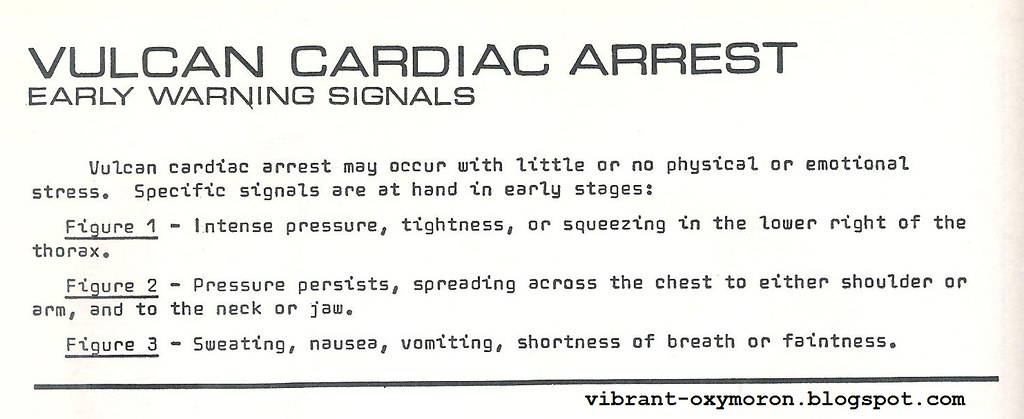
A Vulcan cardiac arrest is caused by a malfunction in one of the heart valves (for diagram of heart, go HERE). It is similar to heart attacks in a human, however it is almost impossible to tell for sure without an operation.

If you recall (and I hope you do!), Sarek suffered from a cardiac arrest (as he had been for quite some time already) during the Coridan debate in "Journey to Babel". Without a transfusion, the operation would not have been carried out because of the unique structure of the Vulcan heart (ordinary heart surgery is impossible as well, it must be specialized and use specific equipment). Luckily both Sarek and Spock had T-negative blood, and were compatible despite the fact that Spock does have some human elements in his blood.


Going back to the handy Star Fleet Medical Reference Manual I had mentioned in an earlier post, we find a handy little chart for diagnosing cardiac arrest in Vulcans, complete with warning signs and a spiffy diagram.


Interestingly enough (or not) the Vulcan in the diagram kind of resembles Sarek.


Basically, heart failure in Vulcans is caused by pulmonary and systemic congestion, in turn caused by inadequate systolic flow and the delayed venous return of copper-based blood.

The drug Benjisidrine, originally synthesized from the Vulcan benjisi plant, is often prescribed (as it was to Sarek)to prevent congestive heart failure in Vulcans. It increases the strength of myocardial contractions.

The More You Know.

Thursday, 7 July 2011

Cranial, Brain, and Heart Development: Human, Andorian, Klingon, Gorn, Tellarite, Vulcan

Did I ever mention I am the (very) proud owner of the fully illustrated Star Fleet Medical Reference Manual? It is epic - I mean, the medical advisor is listed as Leonard McCoy, MD.


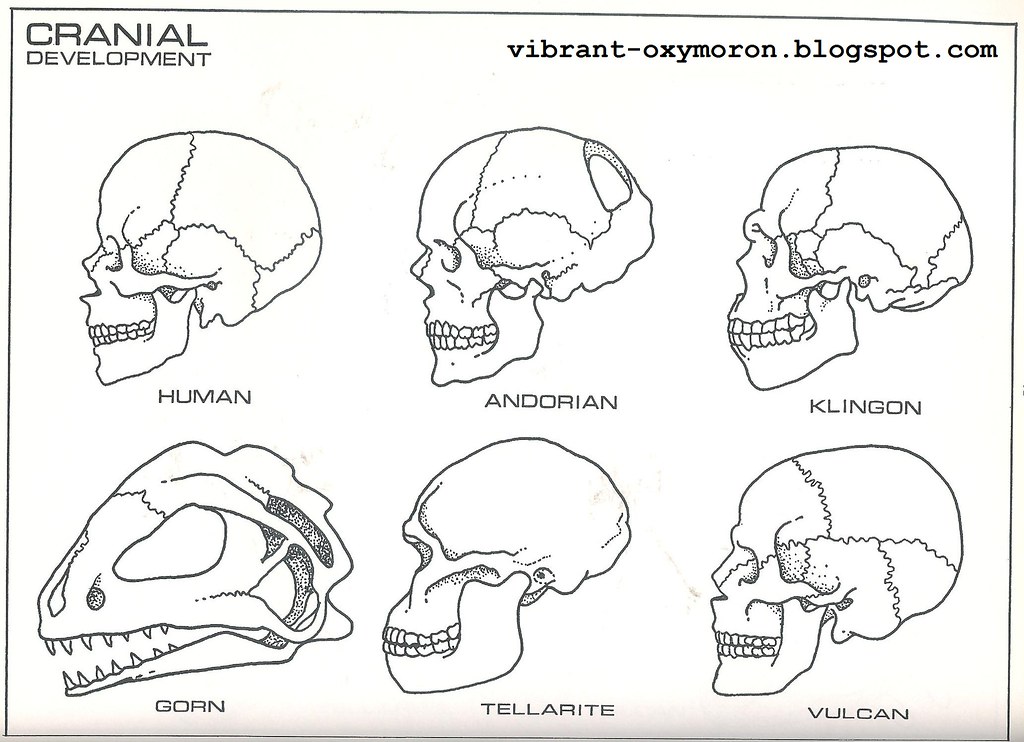
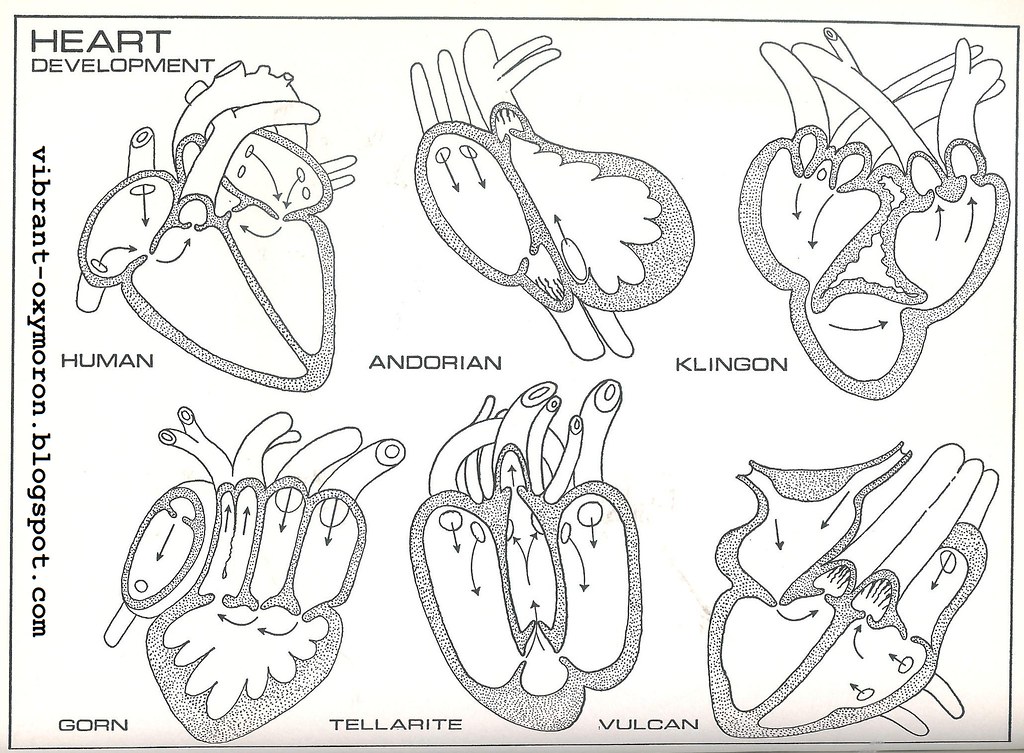
One of the super-cool sections in this book shows the differences in cranial, heart, and brain development between Humans, Andorians, Klingons, Gorn, Tellarites, and Vulcans.

Now anyone who knows me also knows that I somewhat obsessive about Vulcan biology and culture - other species, not as much. Because of this, I will quickly go over what these illustrations tell us about Vulcan physiology, while completely ignoring every other species (except for human).


The Vulcan skull is considerably larger than that of humans, with harder bone that is about 0.2cm thicker around the brain. It is also said that Vulcan males do not possess the "supraorbital taurus" (bony ridges above the eye socket).

Now let's check out them brains!


The Vulcan brain and the Human brain have the same overall structure and size, however the midbrain is significantly different in Vulcans. This midbrain is where telepathic and telekinetic powers originate - the Vulcan midbrain is larger and far more intricate, explaining to a certain extent their psionic powers.

Last one - the heart.


The Vulcan heart beats at 242 minutes, and the average blood pressure is 80 systolic, and 40 diastolic (the blood vessels are extremely dilated). Blood vessels with a large diameter help cool the body. The heart is contained where a the liver would be in a human, thus leaving room for their larger lungs. The cartilage that would normally protect a human heart extends an extra 3.5 cm down to protect the Vulcan heart. The Vulcan heart is somewhat larger in size, extremely muscular, and has thinner walls (to allow for a greater pulse range and a greater volume of blood.

Bonus Fun fact:
Vulcan time is based on the beating of the heart and units of ten. Let's say, for this, that the Vulcan heart beats 240 times per earth minute. 100 Vulcan heart beats is equal to one Vulcan minute. A Vulcan minute is equal to 25 standard seconds, and 24 standard minutes is equal to ten Vulcan minutes. (Strangers from the Sky - Margaret Wander Bonanno)