I have been writing and posting about Vulcan physiology a lot lately, and this will be no different. It is... fascinating.
Did I mention that there will be a post focused on Vulcan reproduction in the next couple days as well?
Anyways, going back to the Star Fleet Medical Reference Manual (again), lets get down to the facts (click to enlarge):
This basically goes over most of what I had mentioned in earlier posts - blood pressure, respiration, etc. However, there are additional details. (Who's ready for more accuracy ranting?)
In novels and fan fiction, there is a recurring theme - Vulcans' "hot" skin. They write about how when a human touches a Vulcan, they are surprised about how warm the Vulcan feels. Obviously, this bothers me. It is a fact that the average body temperature of a Vulcan is 91 degrees Fahrenheit, where as the average human body temperature is 98.6 degrees - Vulcans should then, be colder to the touch, as humans have a much higher body temperature.
Finally, I present to you - a diagram of a Vulcan's internal organs! (yay)
As you can see, the Vulcan heart is indeed where a human liver would be, with the Vulcan liver directly underneath it. The lungs are larger, and their bodies are generally leaner (as evident in top chart, average weight and height).
It is also important to note that this is accurate for all Vulcanoid species, such as Romulans, Mintakans (a proto-Vulcan race), and "Rigel V subspecies".
Wednesday, 13 July 2011
Saturday, 9 July 2011
Sontaran Doctor Who Posters are Cool.
I happen to have a very interesting poster up in my room that I got in the November 1989 Tenth Anniversary issue of Doctor Who Magazine. It features the wonderful Fourth Doctor and three Sontarans:
The interesting thing about this poster is that the Sontarans shown are actually from "The Time Warrior" and battled the Third Doctor. The Fourth Doctor met different looking Sontarans in the serial "The Sontaran Experiment", where they looked less scary, and had goofy expressions on their faces.
The Third Doctor meets these Sontarans:
Which are obviously the ones shown on the poster. (But what about that lighter colored one?) The lighter colored Sontaran was also in "The Time Warrior". (I also thought is was cool that they had hairy eyelids.)
As I mentioned before, the Sontarans that meet the Fourth Doctor look kind of derpy in comparison:
Is it sad that I actually make a fuss over things like this? Perhaps - but these are important things, people! What would my life be without it?
A sad, meaningless void, that's what.
Friday, 8 July 2011
Only I Can Make Spock Pout - Custom Shirts are Cool.
I got a custom order shirt the other day, with a glorious and vibrant picture of Spock pressed onto it. Unfortunately (or hilariously, you decide!) it was printed onto a boy's shirt, which means the picture is distorted when I bend over or when I am gallivanting around and it starts to fit my form. This results in random derp-y and pouty Spock faces, as I shall demonstrate below (click picture to enlarge):
Notice Spock's "derp" face in the top right hand corner, and his pouty face in the bottom. No doubt this is what people see when I am walking down the street and lugging my books around the city. Luckily, I love his face in any form, and I'm just glad to have finally gotten my hands on such an awesome piece of clothing!
Vulcan Cardiac Arrest
A Vulcan cardiac arrest is caused by a malfunction in one of the heart valves (for diagram of heart, go HERE). It is similar to heart attacks in a human, however it is almost impossible to tell for sure without an operation.
If you recall (and I hope you do!), Sarek suffered from a cardiac arrest (as he had been for quite some time already) during the Coridan debate in "Journey to Babel". Without a transfusion, the operation would not have been carried out because of the unique structure of the Vulcan heart (ordinary heart surgery is impossible as well, it must be specialized and use specific equipment). Luckily both Sarek and Spock had T-negative blood, and were compatible despite the fact that Spock does have some human elements in his blood.
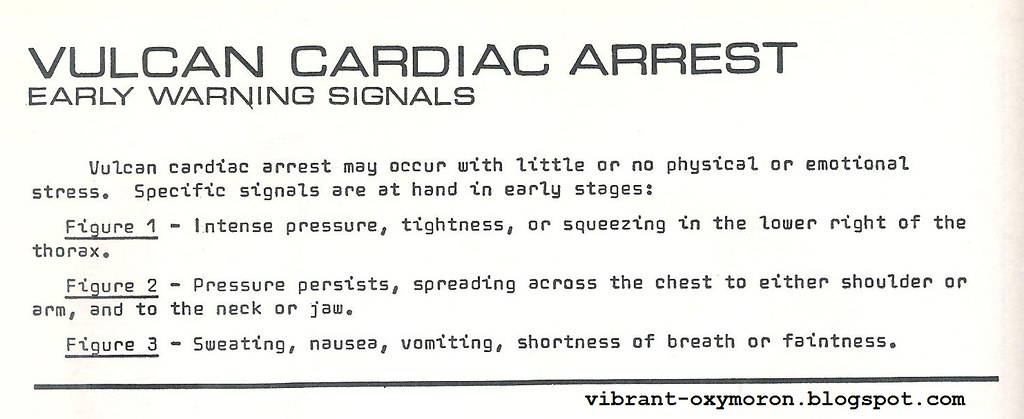
Going back to the handy Star Fleet Medical Reference Manual I had mentioned in an earlier post, we find a handy little chart for diagnosing cardiac arrest in Vulcans, complete with warning signs and a spiffy diagram.
Interestingly enough (or not) the Vulcan in the diagram kind of resembles Sarek.
Basically, heart failure in Vulcans is caused by pulmonary and systemic congestion, in turn caused by inadequate systolic flow and the delayed venous return of copper-based blood.
The drug Benjisidrine, originally synthesized from the Vulcan benjisi plant, is often prescribed (as it was to Sarek)to prevent congestive heart failure in Vulcans. It increases the strength of myocardial contractions.
The More You Know.
Subscribe to:
Posts (Atom)